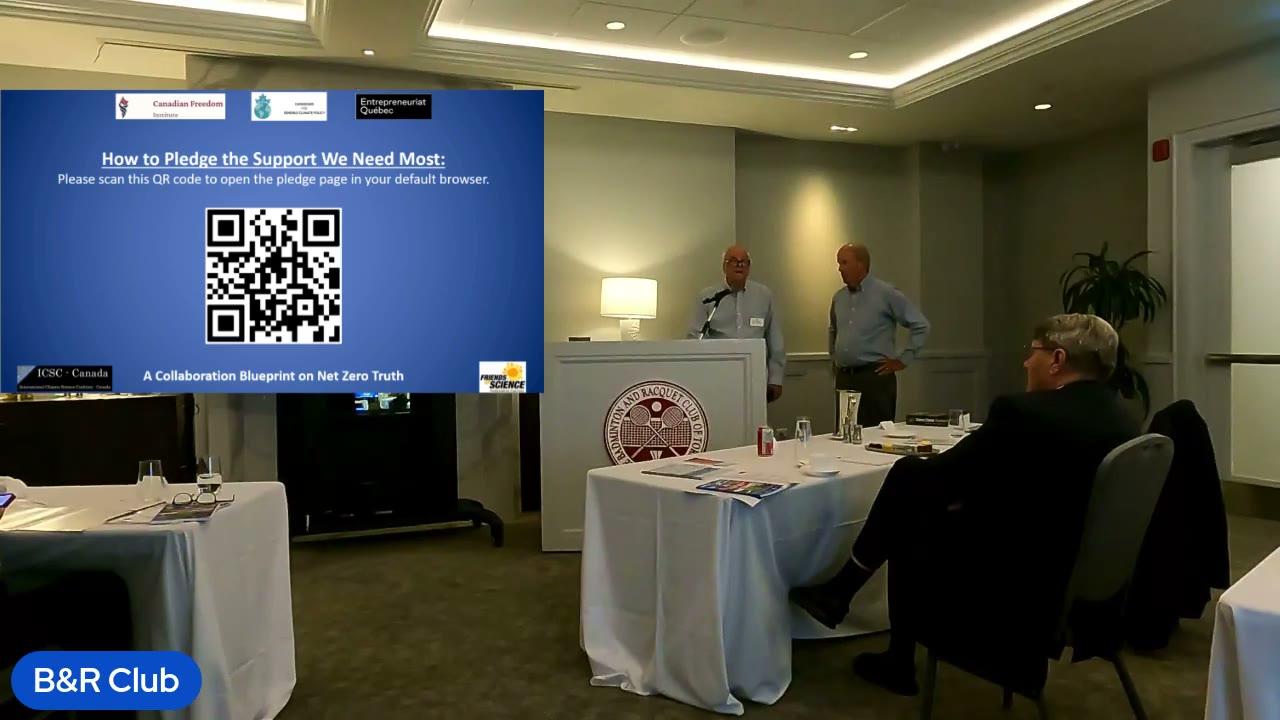
Speakers at the front of the room at the Toronto event
Canadians forSensible Climate Policy

Event replays, June 2026

Canada’s climate-realist organizations met in June 2026 for the science, the evidence, and a plan to work together. Every talk is here as an edited clip. Pick one to watch.

12 talks, edited for watching.

The talks

12 talks in 4 chapters. Pick one to jump straight to it.

  1. 01The cost3 talks
  2. 02The science4 talks
  3. 03Food & farming2 talks
  4. 04The movement3 talks

Chapter 01 / 04

The cost

What Net Zero would cost Canada, who is pushing it, and why the flagship projects disappoint.

01/ 12

Net Zero? The Treatment Is Killing the Patient

  • Tom Harris, ICSC-Canada

Tom Harris compares Net Zero to medieval bloodletting and runs through the cost estimates, from RBC and the federal budget to Ross McKitrick, McKinsey, and the Copenhagen Consensus. His point: even that spending wouldn’t reach the 2050 target.

02/ 12

Canada Caught in a Green Spider Web

  • Michelle Stirling, Friends of Science Society

In a recorded talk, Michelle Stirling traces how foreign funding of environmental groups, Bill C-69, financial institutions, and carbon markets lock Canada into Net Zero, and describes Friends of Science’s letters to OSFI on the RCP 8.5 scenario.

03/ 12

Wind West: Why Large-Scale Wind Disappoints

  • Ron Barmby, P.Eng.

Ron Barmby predicts trouble for Nova Scotia’s Wind West project for three reasons: intermittent power costs the grid more, the environmental impacts (birds, whales, landfilled blades) are unresolved, and energy security is put at risk, as Germany learned in 2021–22.

Chapter 02 / 04

The science

What the physics, the temperature record, and the emissions data actually show.

04/ 12

Do Science and Observations Support Net Zero Policies?

  • Prof. William A. van Wijngaarden, York University

Professor van Wijngaarden walks through the hard data — greenhouse gas physics, observed temperature trends, Arctic ice, wildfires, hurricanes, ocean acidification, and crop yields — and asks whether the observations actually justify Net Zero policy.

05/ 12

Social Costs of GHG Gasses

  • Ken Gregory, Friends of Science Society

Ken Gregory re-runs the ‘social cost of carbon’ with observation-based climate sensitivity and finds a net benefit from CO₂, around $7–10 per tonne, against Environment Canada’s $271 per tonne cost.

06/ 12

Data Homogenization of Erroneous Temperature Records

  • Dr. Sterling Burnett, Heartland Institute

Joining remotely from Texas, Dr. Sterling Burnett exposes how temperature stations are compromised by urban heat and how ‘homogenized’ data distorts the record, plus an update on the legislative situation in the United States.

07/ 12

Natural Emissions of Methane Exceed Those from Human Causes

  • Dr. Joseph Fournier, Frontier Centre for Public Policy

Dr. Joseph Fournier compares biogenic methane from Alberta’s wetlands and agriculture against oil & gas fugitive emissions, and asks whether Canada’s methane regulations target the right source.

Chapter 03 / 04

Food & farming

How climate policy reaches the grocery bill, and the case against blaming beef.

08/ 12

The Price of Virtue: Climate Policy and Food Prices

  • Prof. Sylvain Charlebois, Dalhousie University

Canada’s food inflation is the highest in the G7, and carbon pricing weighs on the whole agri-food chain, according to two studies from Sylvain Charlebois’s lab. Climate change does threaten farming, he says, but Ottawa imposes these policies without planning for affordability or measuring their effect on the climate.

09/ 12

Is Beef Killing the Planet?

  • Linnea Lueken, Heartland Institute

A Heartland Institute film made with Stossel TV: Linnea Lueken takes on the claim that beef is killing the planet, with the CO2 Coalition’s Greg Wrightstone and ranchers.

Chapter 04 / 04

The movement

Training volunteers, building allies at home and abroad, and taking the case to Québec.

10/ 12

Training Volunteers: Lessons from Ottawa’s Municipal Election

  • Tom Harris, ICSC-Canada

Tom Harris recounts how his team took on Catherine McKenney’s climate plan in the 2022 Ottawa mayoral race with a report, interviews, flyers, and prepared debate questions, and lays out how CSCP’s Pathfinders will be trained to do the same.

11/ 12

James Taylor — Heartland Institute

  • James Taylor, Heartland Institute

James Taylor, President of the Heartland Institute, describes Heartland’s work abroad, from Poland’s Solidarity union to Heartland UK and a new office in Warsaw, and urges support for the Canadian Freedom Institute and its allies.

12/ 12

Richard Décarie — Réalisme Climatique

  • Richard Décarie, Réalisme Climatique

Joining remotely from Québec, Richard Décarie launches Réalisme Climatique, Canada’s first French-language climate-realism podcast, and explains why Québec, with its consumer carbon tax and natural-gas ban, is the primary battleground.

Help make the 2026 plan happen

The collaboration unveiled at these events depends on supporters like you. Join CSCP or chip in to keep the evidence flowing.